By Fatima Bokhari
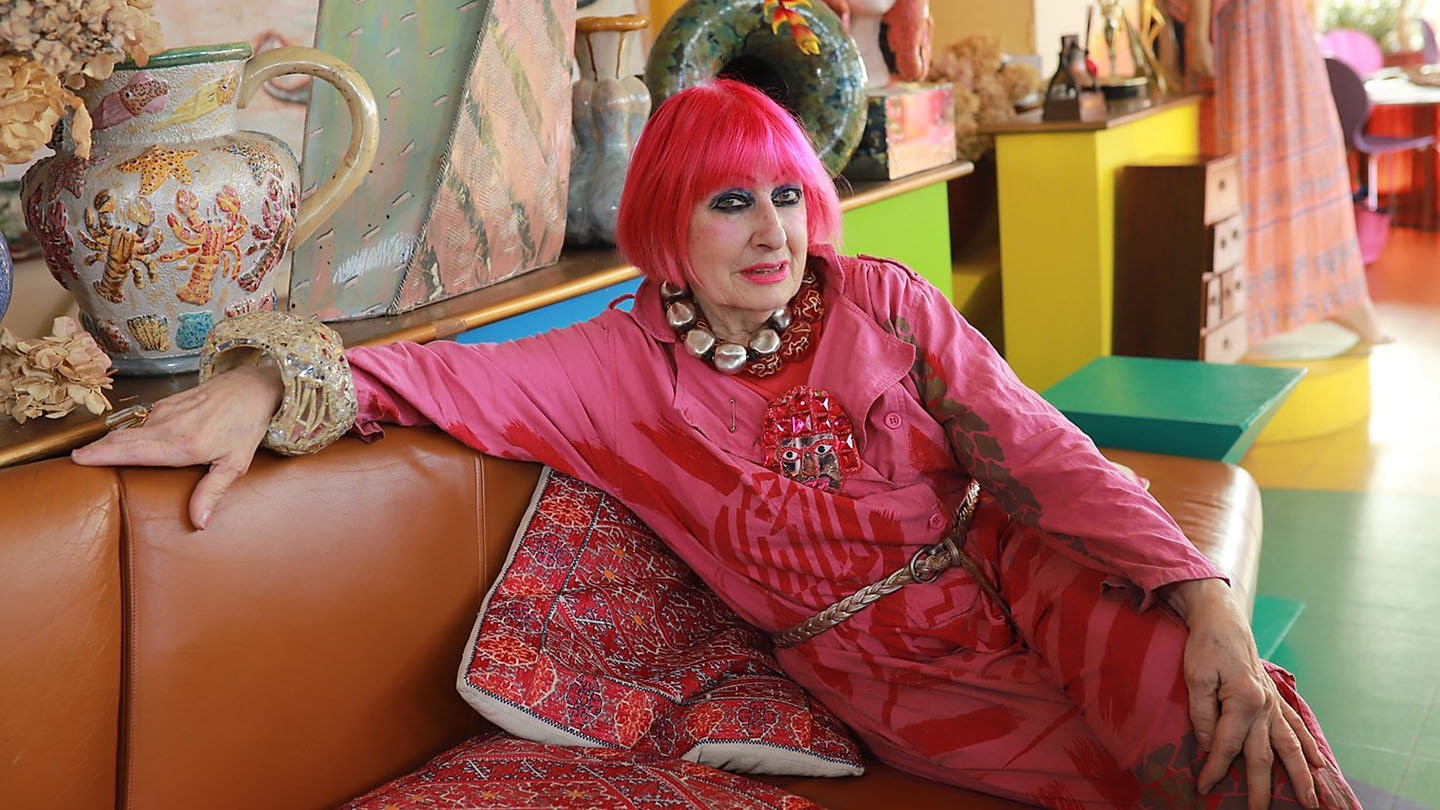
In early May this year, I stepped into a world that felt suspended between memory and imagination at the Rainbow Penthouse in London, home of one of Britain’s most singular fashion voices…Zandra Rhodes.
The occasion was her Spring Sale Exhibition, a gathering that drew collectors, designers, students, and longtime admirers into her orbit. But calling it a “sale” felt almost reductive. A life still being actively written in flowing silhouettes, hand-printed pattern, and the quiet drama of colour left to speak for itself.

Rhodes has spent over five decades reshaping the language of fashion. Known globally as the “Princess of Punk,” she emerged as a force who refused restraint, turning textiles into statements, silhouettes into theatre, and colour into defiance. Her work has lived on some of the most recognisable figures of modern culture, from Princess Diana to Freddie Mercury, each garment carrying her unmistakable sense of drama and liberation.

Yet what lingers about her legacy is not only who she has dressed, but how she has continued to exist inside her own work, without dilution, without retreat.
She’s still creating…incredible. Still sketching. Still exhibiting. Still building new worlds from the same restless curiosity that defined her earliest years. Her books, part autobiography, part archive of imagination, offers more than a record of success. They read like a study in persistence: of a woman who never treated creativity as something to be completed, only something to be practised.

The Rainbow Penthouse itself felt like a continuation of that philosophy: layered walls, a terrazzo floor embedded with stars and scattered gems that caught the light underfoot, colour that didn’t coordinate so much as collide. It didn’t ask for quiet admiration; it insisted on feeling.
Finding it, however, felt like a small adventure of its own. While searching for Rhodes’s apartment within the building, I suddenly heard the unmistakable sound of Michael Jackson drifting through the corridor. Following the music led me directly to the correct door, as though the penthouse was announcing itself before I had even arrived. Inside, the visitors reflected the same spectrum. Youngsters stood in quiet awe beside seasoned fashionistas and collectors who had followed her work for decades. Designers, artists, and admirers moved through the rooms with a kind of unspoken recognition, like everyone was briefly participating in the same creative current. Michael Jackson songs continued to play in the background, as if even the playlist understood the assignment.

At a time when so much of our interaction was flattened into screens and scrolls, being in that room felt almost radical. Creativity was not being consumed…it was being shared.
We often say that the world is getting smaller. And in many ways, it is. A textile in London can inspire a silhouette in Lahore within minutes. A sketch in one hemisphere can become a garment in another before the week ends. We are living inside a global jungle of influence…dense, interconnected, overwhelming in its reach.
But what this closeness demands is discernment. Not everything accessible is instructive. And not everything visible is meaningful.

As artists and creatives, we are surrounded by the work of those who came before us more than ever before. Yet proximity does not automatically translate into understanding. The greats are not just to be seen, they are to be studied, sat with, and slowly understood over time.
Meeting Rhodes brought this into sharp focus for me. There was something disarming about witnessing longevity in real time. Not as myth, not as retrospective praise, but as presence. She was not speaking about her career as something finished. She was still inside it. Still extending it.
That was where the idea of creative longevity began to shift for me. It is not about endurance alone. It is about refusal…the refusal to treat creativity as something that has an expiry date.

As the founder of my apparel brand, Princess & The Cake, I often think about slowness in a world that rewards speed. Our work is rooted in craft, in handwork, in techniques that take time to master and even longer to forget. In that sense, Rhodes felt like a kindred force, someone who has never separated making from meaning.
Her career reinforces something quietly radical: that authenticity does not age out. It accumulates depth. It gathers weight. It becomes more itself over time.
What is often left unsaid in creative industries is how easily experience gets sidelined in favour of novelty. But Rhodes stands as a living contradiction to that idea. She is not preserved in nostalgia, she is actively expanding. Still taking up space. Still insisting on colour, on form, on imagination. And perhaps that is what stayed with me most after leaving her home…the feeling of witnessing someone still in conversation with their own imagination after so many decades.

So many creatives spend their lives chasing relevance, as though it is something external to be caught. Zandra Rhodes suggests something else entirely: that relevance is often the echo of commitment. Of showing up again and again to the same inner voice, without certainty that it will always be understood.
When I left the Rainbow Penthouse, London felt slightly altered…less like a city, more like a continuation of that colour-soaked world I had just stepped out of. The greatest artists do not simply leave behind work. They leave behind evidence that creativity does not have an ending point.
Only continuation.
Header image courtesy of: The Industry Fashion